
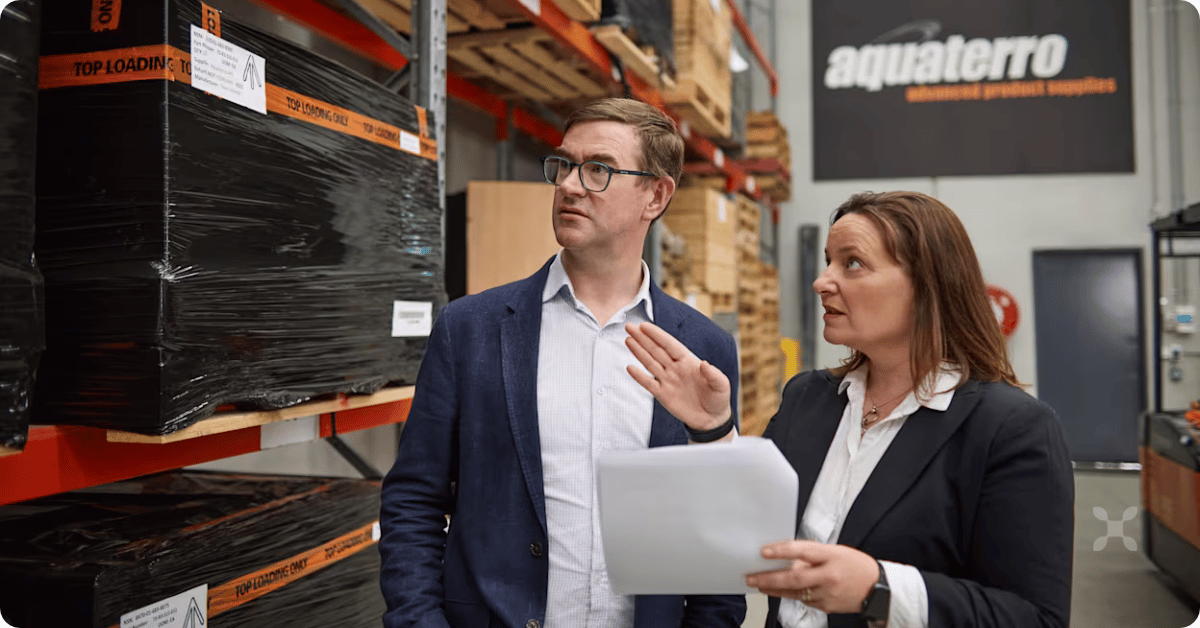
The best ERP for Australian manufacturers depends on production complexity, inventory requirements and company structure. MYOB Acumatica is a strong all-round choice for Australian mid-market manufacturers, while Epicor Kinetic and SYSPRO suit complex production environments, Business Central and Wiise suit Microsoft-centric businesses with simpler manufacturing, Pronto Xi offers an Australian-developed option, and NetSuite is well suited to multi-entity and international manufacturing groups.
Manufacturing
Cloud ERP
Comparison Guide
Best ERP Software for Manufacturers in Australia | 2027 Guide

Christian Galaz
Best ERP Software for Manufacturers in Australia | 2027 Guide
25:50
Quick answer from BusinessHub: What is the best ERP for Australian manufacturers in 2027?
MYOB Acumatica is a strong all-round choice for Australian mid-market manufacturers that need manufacturing, inventory, production planning, finance and Australian payroll capabilities within one cloud ERP environment.
Manufacturers with particularly complex discrete or engineer-to-order production may also shortlist Epicor Kinetic or SYSPRO, while Pronto Xi is worth considering for businesses that prefer an Australian-developed ERP platform.
Microsoft Dynamics 365 Business Central and Wiise can suit manufacturers with less complex production requirements, particularly organisations already invested heavily in the Microsoft ecosystem.
NetSuite deserves consideration where international subsidiaries, global financial consolidation and multi-entity management are bigger priorities.
The important point is that the best manufacturing ERP isn't necessarily the system with the longest feature list. It is the system that best fits how your factory actually operates.
Why 2027 changes the ERP conversation for manufacturers
A manufacturer might have been able to tolerate disconnected systems when it operated from one warehouse, produced a relatively small range of products and had a handful of people responsible for inventory.
Growth changes that. A business might now have:
- thousands or even hundreds of thousands of SKUs
- several warehouses or production locations
- increasingly complex bills of materials
- raw materials, components, subassemblies and finished goods
- make-to-stock and make-to-order production
- batch, lot or serial tracking requirements
- interstate or international suppliers
- longer and more unpredictable lead times
- several legal entities
- more people requiring access to operational information.
At that point, the problem normally isn't that the business needs better accounting software. It needs better enterprise resource planning. And that distinction should shape your ERP shortlist for 2027.
The 2027 manufacturing ERP test
Instead of starting your ERP evaluation with vendors, start with five questions about your operation.
1. Can you trust your inventory numbers?
This sounds basic, but it is one of the most important tests of any manufacturing system.
You should be able to answer: What do we have? Where is it? What is committed? What is available for production? And what do we need to buy?
For manufacturers, good inventory management needs to go well beyond recording purchases and sales.
Depending on the business, you may require:
- multi-location inventory
- lot and serial tracking
- barcode scanning
- landed cost management
- automated replenishment
- raw material availability
- work-in-progress visibility
- finished goods inventory
- expiry management
- inventory allocation
- demand forecasting.
If employees regularly export inventory into spreadsheets before they trust it, that is an important warning sign.
Your ERP needs to become the operational source of truth.
2. Can production planning keep pace with demand?
This is where genuine manufacturing ERP starts to separate itself from general business management software.
Australian manufacturers evaluating ERP should look closely at:
- multi-level bills of materials
- routings
- work centres
- material requirements planning (MRP)
- production orders
- work-in-progress
- labour and machine costs
- production scheduling
- capacity planning
- demand planning
- production costing.
But don't simply ask the ERP vendor whether these capabilities exist.
Ask them to demonstrate them using your manufacturing scenario.
For example: “Here’s one of our more complicated products. Show us how a confirmed customer order changes material requirements, purchasing, capacity, production scheduling and inventory.”
That tells you considerably more than watching another generic ERP demonstration.
3. Can you trace what went into a finished product?
Traceability is becoming increasingly important across Australian manufacturing, particularly in food and beverage, defence, medical products and other regulated or quality-sensitive environments.
A capable ERP should make it possible to move backwards and forwards through the supply chain.
For example: Supplier → raw material → lot → production order → finished product → customer
If a quality problem appears months later, the system should help determine which materials were involved and which customers received affected products without teams searching through spreadsheets, paperwork and separate databases.
For some manufacturers, this capability should carry considerably more weight in ERP selection than CRM, dashboards or user-interface preferences.
4. Do you know what each product really costs to make?
Many manufacturers know their revenue by product, but not the true margin on each one.
Your ERP should bring together the actual cost of materials, labour, machine time and overheads for every production order, then compare it with the standard or quoted cost.
Look for:
- standard and actual costing
- material, labour and overhead variances
- costed bills of materials and routings
- work-in-progress valuation
- margin reporting by product, customer and job.
If product costs are still worked out in spreadsheets after month-end, pricing decisions are being made on old information.
5. Can finance and operations see the same numbers?
In many factories, operations trusts one set of figures and finance trusts another.
When purchasing, inventory, production and finance run in one ERP, stock movements and production costs flow straight into the general ledger. Month-end becomes a check rather than a reconciliation exercise.
Ask each vendor to show how inventory valuation, work-in-progress and cost of goods sold are posted, and how quickly management can see margin by product line, site or entity.
Best ERP software for Australian manufacturers heading into 2027
Rather than ranking platforms from one to seven, the better approach is to ask which ERP fits which manufacturing environment.
|
ERP |
Strongest fit |
Key consideration |
|
MYOB Acumatica |
Australian mid-market manufacturers wanting manufacturing, inventory, finance and payroll in one cloud environment |
Broad functionality makes good implementation planning important |
|
Epicor |
Complex discrete, make-to-order and engineer-to-order manufacturing |
Manufacturing depth can increase implementation complexity |
|
SYSPRO |
Manufacturing businesses prioritising production control and traceability |
Evaluate local implementation resources carefully |
|
Pronto Xi |
Manufacturers prioritising an Australian-developed ERP |
Smaller implementation ecosystem than some international platforms |
|
Business Central |
Microsoft-centric organisations with relatively straightforward manufacturing |
More advanced manufacturing requirements may need extensions |
|
Wiise |
Australian businesses wanting Business Central technology with Australian localisation |
Best suited to comparatively straightforward production requirements |
|
NetSuite |
Multi-entity or internationally expanding manufacturing groups |
Australian payroll and deeper manufacturing requirements need careful assessment |
Importantly, this isn't a league table.
A specialised engineer-to-order manufacturer may reasonably choose Epicor Kinetic over MYOB Acumatica. A multinational group could prioritise NetSuite. A manufacturer heavily standardised on Microsoft may prefer Business Central.
Fit matters more than ranking.
A note on where we stand: BusinessHub implements MYOB Acumatica, Wiise and Microsoft Dynamics 365 Business Central. We have included Epicor Kinetic, SYSPRO, Pronto Xi and NetSuite because they are genuine options for some Australian manufacturers.
MYOB Acumatica: Strong all-round choice for Australian mid-market manufacturers
MYOB Acumatica is particularly well suited to Australian manufacturers that have outgrown Xero, MYOB Exo or disconnected inventory and production applications and want to bring operations and finance together.
Depending on the edition and modules you license, its manufacturing capabilities include areas such as:
- bills of materials
- production orders
- material requirements planning
- estimating
- production scheduling
- product configuration
- lot and serial tracking
- inventory management
- engineering change control.
One of its strongest arguments for an Australian manufacturer is the breadth of the platform.
Instead of evaluating manufacturing independently from accounting, inventory, payroll and other business functions, these processes can form part of one broader ERP environment.
Best suited to: Growing Australian mid-market manufacturers wanting an ERP that can connect production, inventory, finance, payroll and wider business operations.
Watch for: The breadth and configurability of the platform means implementation scope matters. Don't try to replicate every historical process or switch on every available capability during phase one. Our MYOB Acumatica review for manufacturers covers the strengths and trade-offs in more detail.
Epicor Kinetic: Strong option for complex production
Epicor Kinetic has a long manufacturing heritage and deserves consideration when production itself is the most difficult part of your ERP requirements.
Its strengths include areas such as:
- complex bills of materials
- MRP
- job management
- shop-floor control
- advanced scheduling
- quality management.
That can make it particularly relevant for discrete, make-to-order and engineer-to-order production environments.
Best suited to: Manufacturers where production scheduling and detailed shop-floor control outweigh broader simplicity as selection criteria.
Watch for: The deeper the manufacturing environment, the more important implementation effort, training and change management become.
SYSPRO: Strong for manufacturing and distribution control
SYSPRO has traditionally concentrated heavily on manufacturing and distribution.
That makes it worth considering for manufacturers where production management, inventory control and traceability are core requirements rather than secondary modules.
Best suited to: Manufacturing and distribution organisations wanting a system with a strong operational focus.
Watch for: Australian manufacturers should assess the local partner ecosystem and support model alongside functionality.
A technologically capable ERP still needs a capable local implementation team.
Pronto Xi: Australian-developed ERP for manufacturing
Pronto Xi differentiates itself by being developed in Australia and having a long-standing presence in Australian manufacturing and distribution.
Its manufacturing functionality covers areas such as manufacturing planning, MRP, production scheduling and shop-floor processes.
Best suited to: Manufacturers that put a high value on Australian-developed enterprise software and local market knowledge.
Watch for: Consider your preferred implementation and support model, as well as your longer-term cloud strategy.
Microsoft Business Central: Strong Microsoft ecosystem option
Business Central is Microsoft's cloud ERP for small and mid-sized organisations and is a natural consideration for manufacturers already heavily invested in Microsoft technology.
Manufacturing functionality is available through Business Central Premium and includes production BOMs, production orders, routings and capacity planning.
The broader appeal often comes from its connection with familiar Microsoft tools such as Excel, Outlook, Teams and Power BI.
Best suited to: Microsoft-centric businesses with relatively straightforward manufacturing requirements.
Watch for: More advanced scheduling, shop-floor or industry-specific requirements can require extensions.
Assess the entire proposed solution, including third-party applications, rather than assessing Business Central alone.
Wiise: Australian ERP built on Microsoft technology
Wiise combines Business Central technology with localisation for Australian organisations.
For manufacturers, it can offer a useful step between smaller accounting and inventory systems and more complex manufacturing ERP environments.
Best suited to: Australian businesses with simpler manufacturing or assembly requirements that want a cloud platform based on Microsoft technology.
Watch for: Complex MRP, shop-floor or scheduling requirements need to be tested in detail rather than assumed from the manufacturing feature list.
NetSuite: Strong for multi-entity and international growth
NetSuite approaches the manufacturing decision from a somewhat different direction.
Its strength lies in providing a broad cloud ERP environment covering financials, inventory, supply chain and multi-entity management.
That can be particularly valuable to Australian manufacturers expanding overseas or managing multiple subsidiaries.
Best suited to: Manufacturers where global financial management, multiple entities and international expansion are major requirements.
Watch for: If your greatest complexity exists on the factory floor rather than in your corporate structure, test production planning, Australian payroll and shop-floor requirements carefully before making a decision.
Don't choose your 2027 ERP using a feature checklist
One of the easiest ERP selection mistakes is creating a spreadsheet with several hundred requirements and asking vendors to respond with:
Yes / No / Customisation Required
Eventually, virtually every ERP looks the same.
A better approach is to identify the 10 to 15 operational scenarios that make your manufacturing business difficult to run.
For example:
Scenario 1: Material shortage
A major customer increases an order by 40%. Which raw materials are now short, when can we purchase them and what happens to scheduled production?
Scenario 2: Production delay
A machine is unavailable for two days. Which production orders and promised customer dates will be affected?
Scenario 3: Quality issue
A supplier advises that a raw-material batch is potentially defective. Which production runs used it and which customers received the finished products?
Scenario 4: Margin investigation
A product appears profitable when quoted but its actual margin is declining. Can we see material, labour and overhead variance?
Scenario 5: Inventory availability
Sales receives an urgent order for 500 units. How quickly can they determine what is available, what is committed and when the remaining quantity can be manufactured?
Ask every shortlisted ERP provider to demonstrate the same scenarios.
Now you are comparing manufacturing outcomes, not sales demonstrations.
Think about 2030 when choosing your 2027 ERP
ERP implementations aren't short-term projects. A platform selected during 2027 could still be central to the business in 2030, 2032 or beyond.
So don't only document today's organisational structure. Consider what could change.
Will you have:
- another warehouse?
- another factory?
- additional legal entities?
- substantially more SKUs?
- more automation?
- ecommerce or dealer portals?
- international operations?
- acquisitions?
- more sophisticated planning?
- new compliance requirements?
- significantly more ERP users?
There is no value buying an oversized enterprise platform purely because you might require it someday.
But there's equally little value implementing an ERP the business is likely to outgrow again. The sweet spot is enough functionality for today, with credible headroom for tomorrow.
Selecting the right implementation partner
For Australian manufacturers, selecting the software is only half of the decision. The implementation partner determines how that software gets translated into purchasing, inventory, production, finance and warehouse processes.
Before selecting a partner, ask:
- How many Australian manufacturing ERP projects have you delivered?
- Have you worked with manufacturers like us?
- Can we speak to comparable customers?
- Who will actually be assigned to our project?
- How will you scope production requirements?
- How will historical data be migrated?
- How will BOMs, routings and inventory data be validated?
- What happens after go-live?
A well-configured ERP with a strong implementation partner is usually a better outcome than a theoretically more powerful ERP implemented poorly.
BusinessHub is an MYOB Acumatica Platinum Partner and was named MYOB's 2023 Manufacturing Partner of the Year. Founded in 1999, with offices in Melbourne and Hobart, we delivered the first MYOB Acumatica solution in ANZ. See the results in our Kosmea and Aquaterro case studies, or read our guide to choosing a MYOB Acumatica partner.
Planning an ERP project for 2027? Start before 2027
For manufacturers considering replacing their current systems next year, waiting until January to start evaluating ERP can unnecessarily push the project further into 2027.
The work that can begin now includes:
- documenting current systems
- identifying spreadsheet-dependent processes
- reviewing inventory and master-data quality
- defining manufacturing requirements
- mapping critical production workflows
- agreeing on project goals
- identifying internal stakeholders
- building a shortlist
- preparing scripted demonstration scenarios.
This doesn't commit you to an ERP vendor. It makes you a better ERP buyer.
Which manufacturing ERP should you shortlist for 2027?
Start with your biggest source of operational complexity.
If manufacturing, inventory and Australian business requirements all matter:
Consider MYOB Acumatica.
If detailed production scheduling is the dominant requirement:
Consider Epicor Kinetic or SYSPRO.
If Australian-developed software is important:
Consider Pronto Xi.
If Microsoft integration is the priority and production is comparatively straightforward:
Consider Dynamics 365 Business Central or Wiise.
If multi-entity and international expansion dominate the decision:
Consider Oracle NetSuite.
Then validate the shortlist against your own production scenarios.
The question isn't: Which ERP has the most features?
It’s: Which ERP can run our manufacturing business with fewer workarounds as we grow over the next three to five years?
That's the question worth answering before 2027 begins.
Frequently Asked Questions
What is the best ERP software for Australian manufacturers?
There is no single ERP that's right for every Australian manufacturer. MYOB Acumatica is a strong all-round option for mid-market manufacturers requiring production management, inventory, finance and Australian business functionality. Epicor Kinetic and SYSPRO are strong candidates where production scheduling is particularly complex, while NetSuite can suit international and multi-entity manufacturing groups.
What should manufacturers look for in ERP software?
Manufacturers should assess bills of materials, MRP, production scheduling, capacity planning, WIP, inventory management, lot and serial traceability, costing, warehouse management and integration between production and finance. Australian businesses should also evaluate local payroll, taxation, implementation expertise and ongoing support.
What is manufacturing ERP?
Manufacturing ERP is enterprise resource planning software that connects production management with inventory, purchasing, finance and other business processes. Unlike accounting software, manufacturing ERP can manage bills of materials, work orders, production schedules, material requirements and work-in-progress alongside financial information.
When should a manufacturer move to an ERP?
A manufacturer should consider ERP when spreadsheets and disconnected applications make it difficult to trust inventory, plan production, calculate product costs, manage multiple locations or obtain timely financial and operational information.
Is cloud ERP suitable for Australian manufacturing businesses?
Yes. Modern cloud ERP platforms can support complex Australian manufacturing operations across production, inventory, finance, purchasing and multiple locations. The important consideration is not simply whether an ERP is cloud-based, but whether its manufacturing functionality matches the company's production environment.
How long does manufacturing ERP implementation take?
Most MYOB Acumatica implementations take three to six months. Implementation varies significantly according to manufacturing complexity, data quality, integrations, customisation and the number of sites involved. A manufacturer replacing several disconnected systems will generally require greater preparation than a business implementing primarily financial and inventory functionality.
Get your manufacturing systems ready for 2027
If spreadsheets, disconnected inventory systems and manual production processes are making it harder to plan manufacturing, trust your stock or understand costs, 2027 may be the right time to rethink your business systems.
BusinessHub helps Australian manufacturers assess their existing systems, define ERP requirements and determine whether platforms such as MYOB Acumatica, Wiise or Microsoft Dynamics 365 Business Central are a suitable fit.
Our best advice? Start with a Business System Review before booking your next ERP demo.