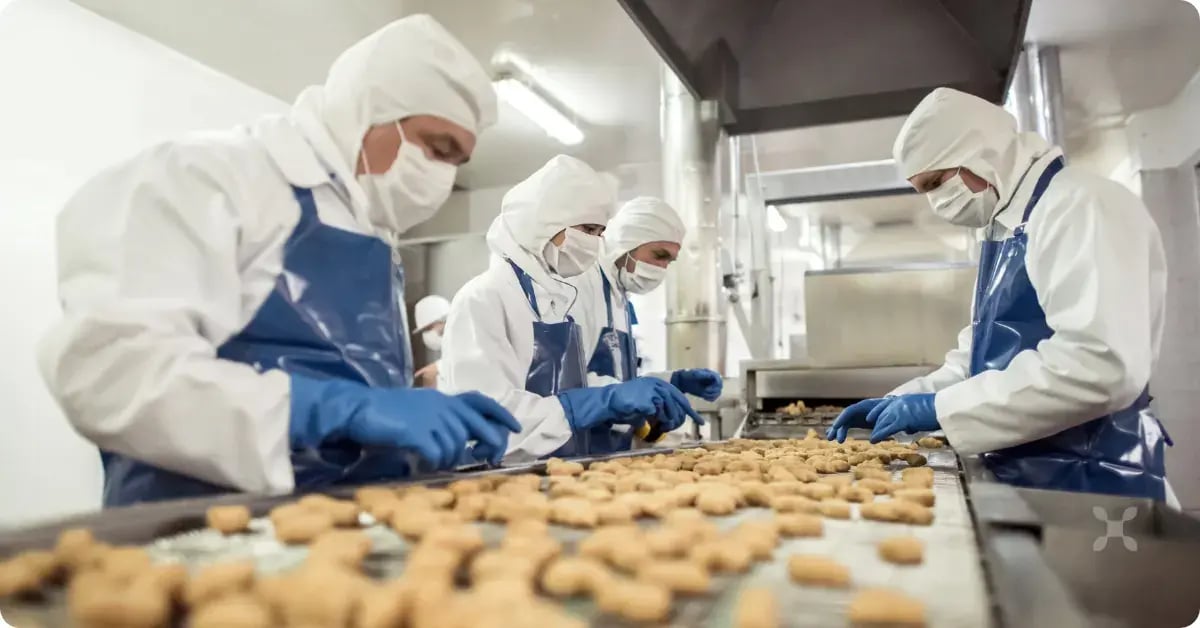
One bad batch can put your brand on the national recall list. If your batch records live in spreadsheets, your recipes sit in someone's inbox and a mock recall takes a day, this guide shows you which ERP fixes that fastest, and what each one will cost you in trade-offs.
Key takeaways
- Food manufacturers should judge ERP on four tests: production control, traceability and recall, compliance fit and local implementation support.
- MYOB Acumatica scored 18/20. It brings recipes, batch production, lot tracking, inventory, finance and Australian payroll into one cloud system hosted in Australia, and Quality Management, now part of the platform, adds QC inspections, CAPA and Certificates of Analysis.
- Aptean Food & Beverage ERP and SYSPRO scored 5/5 for traceability and recall, with built-in FEFO and recall tools.
- Pronto Xi (16/20) is the strongest Australian-developed option, with recipes, yields, co-products and lab testing.
- FSANZ coordinated 92 food recalls in 2025, and undeclared allergens and microbial contamination were the most common reasons from 2021 to 2025.
- Run a live mock recall in every demo. It is the fastest way to see which system will protect your brand.
Food ERP scorecard for Australian manufacturers
If you're comparing Australian manufacturing software for a food plant, here is how seven ERP platforms score. Each one is scored from 1 (weak) to 5 (best in class) on four tests.
| Platform |
Production control |
Traceability and recall |
Compliance fit |
Local implementation support |
Total |
Best for |
| MYOB Acumatica |
4 |
4 |
5 |
5 |
18 |
Mid-sized food and beverage manufacturers that want one cloud system for the whole business |
| Aptean Food & Beverage ERP |
4 |
5 |
4 |
3 |
16 |
Food manufacturers that need catch weight, allergen and recall tools out of the box |
| Pronto Xi |
4 |
4 |
5 |
3 |
16 |
Food manufacturers that want Australian-developed software with lab and quality management |
| SYSPRO |
4 |
5 |
3 |
3 |
15 |
Manufacturers that put lot traceability and FEFO first |
| Wiise |
3 |
4 |
4 |
4 |
15 |
Smaller food producers with simple recipes that want an Australian-localised Microsoft platform |
| MS Dynamics 365 Business Central |
3 |
4 |
3 |
5 |
15 |
Microsoft-centric businesses that will add food extensions and a separate payroll system |
| Infor CloudSuite |
5 |
5 |
3 |
2 |
15 |
Large, multi-site food groups with an internal ERP team |
Scores are BusinessHub's assessment for a typical Australian mid-sized food or beverage manufacturer: $10m to $200m in revenue, one to five sites and a lean finance and operations team. They draw on vendor information checked in November 2026 and our own experience implementing ERP for Australian manufacturers. We implement three of these platforms (MYOB Acumatica, Wiise and Business Central) and scored the other four on public vendor information, so test every claim in a scripted demo.
Don't just add up the totals. Weight the tests that matter most to your plant. A meat or cheese processor that sells by variable weight should weight catch weight heavily. A bakery supplying the major supermarkets should weight allergen control and recall speed.
How we scored each food manufacturing ERP
Every platform here is enterprise resource planning (ERP) software that runs finance, production management, inventory management and supply chain management in one system. What separates them is how well they handle the daily realities of a food factory. These are the four tests we used.
1. Production control
Can the system manage how food is really made? We looked at recipes and formulas, batch production, yields, co-products and by-products, version control, production management, scheduling and costing.
2. Traceability and recall
Can you trace any lot from supplier to customer and back again, fast? We looked at lot and batch tracking, expiry dates, FEFO picking, forward and backward tracing, recall tools, quality control records and catch weight.
3. Compliance fit
Does the system help you meet Australian rules and audits? We looked at support for recall plans and traceability records under the Food Standards Code, allergen data for labelling, quality and HACCP records, GST, BAS and Single Touch Payroll (STP), Australian payroll and where your data is hosted.
4. Local implementation support
Can you find an experienced Australian partner to get you live and keep you running? We looked at the number of local partners with manufacturing experience, typical project effort for a mid-sized team and support after go-live.
What Australian food rules mean for your ERP
Your ERP is where your traceability evidence lives. When an authorised officer or an auditor asks for it, you need answers in minutes, not days.
- You must be able to recall unsafe food: Under Standard 3.2.2 of the Food Standards Code, food manufacturers, wholesale suppliers and importers must be able to recall unsafe food. That means having a written recall plan, using it when needed and showing it to an authorised officer if asked. FSANZ also suggests a practice recall to check that your plan works.
- You must know where food came from: FSANZ says to only accept food when you can identify it and the supplier's name and address, and to keep those details. Labelled food must include lot identification.
- You need the right records: FSANZ lists supplier and customer contact details, what you supply, dates of transactions and deliveries, batch numbers or lot identifiers and quantities supplied or received.
- Allergens must be declared in plain English: Since 25 February 2024, allergens must be declared in bold in the ingredient list, with a separate summary statement starting with "Contains". The sell-through period for older labels ended on 25 February 2026.
The stakes are real. FSANZ coordinated 866 food recalls from 2016 to 2025, an average of 87 a year, including 92 in 2025. From 2021 to 2025, the most common reasons were undeclared allergens and microbial contamination, and mixed or processed foods were the most recalled food type.
An ERP will not write your recall plan for you. What it can do is turn your recall plan from a paper exercise into a few clicks: one lot number in, every supplier, batch, customer and quantity out.
The 7 best ERP platforms for Australian food manufacturers
1. MYOB Acumatica: best all-round ERP for Australian food manufacturers (18/20)
Scores: Production control 4, traceability and recall 4, compliance fit 5, local implementation support 5.
MYOB Acumatica is a cloud ERP localised for Australia and New Zealand by MYOB, the sole provider of Acumatica in both countries. It brings finance, inventory, manufacturing, payroll, CRM and reporting into one browser-based system, so your plant, warehouse and finance team all work from the same numbers.
Why it scores well:
- Recipes and batch production: MYOB Acumatica Manufacturing supports batch process manufacturing, recipes and formulas, BOM versioning, production planning, scheduling and production costing.
- Lot tracking with expiry control: Lot and serial tracking follows materials from receipt through production to finished goods, which is the backbone of a fast recall.
- Shop floor capture: The 2026.1.3 release, rolling out to sites that upgrade from December 2026, adds a Shop Floor Kiosk, where production staff can capture lot and serial details as they work.
- Integrated quality management: Quality Management for MYOB Acumatica is now part of the full MYOB Acumatica ERP platform, so quality control lives in the same system as production and inventory instead of a separate system. It covers QC testing of incoming raw materials, production, purchasing, inventory and shipping, inspection plans and checklists, AQL sampling, internal, customer and vendor non-conformance, CAPA with a complete audit trail, lot and serial tracking across the product lifecycle for easier recalls, Certificates of Analysis and mobile data capture. MYOB says it supports quality standards such as HACCP and ISO 9001.
- Made for Australia: GST, BAS and STP compliance are native, MYOB Acumatica Payroll handles award-based pay for shift workers, and the platform is hosted on Amazon Web Services (AWS) in Australia.
- Clear licensing: MYOB Acumatica uses a named-user subscription model combined with editions, roles and resource entitlements.
Trade-offs: Catch weight and allergen management are not as developed as in food-first ERPs like Aptean, so test them, along with FEFO picking, in a scripted demo. Ask to see Quality Management in your demo, alongside a mock recall. MYOB Acumatica is priced by quote, so you need a scoped proposal to compare total cost.
Choose MYOB Acumatica if: you want recipes, batch production, inventory, finance and payroll in one cloud system, you're moving from Xero, MYOB Exo or spreadsheets, and you want a local partner who knows manufacturing. Read more in our guide to MYOB Acumatica for food manufacturers.
2. Aptean Food & Beverage ERP: best for food-specific features out of the box (16/20)
Scores: Production control 4, traceability and recall 5, compliance fit 4, local implementation support 3.
Aptean Food & Beverage ERP is built on Microsoft Business Central and designed only for food and beverage businesses. Aptean has an office in Sydney.
- Traceability and recall: Bidirectional lot tracking, recall readiness and what Aptean calls one-click recall management.
- Expiry control: Expiry date alerts and built-in FEFO inventory control.
- Food-specific tools: Lot-level and item-level catch weight management, integrated ingredient and allergen management, and built-in quality checks.
Trade-offs: Australian payroll is not part of Business Central, so you will need a separate payroll system. Confirm who will implement and support you locally and how many Australian food manufacturers they have taken live. Ask for a total cost that includes the Business Central licences it runs on.
Choose Aptean if: catch weight, allergen control and recall tools are must-haves on day one and you are comfortable on Microsoft technology.
3. Pronto Xi: best Australian-developed ERP for food manufacturers (16/20)
Scores: Production control 4, traceability and recall 4, compliance fit 5, local implementation support 3.
Pronto Xi is developed by Pronto Software, a 100% Australian-owned company based in Victoria.
- Process manufacturing: Pronto says it supports process manufacturing, including recipes, batches, yields and co-products.
- Traceability: Inventory, lot, batch and serial number tracking.
- Quality: Quality management, lab testing and non-conformance reporting.
- Local by design: Pronto says its cloud keeps all data in Australia, with SaaS, hosted and on-premises options.
Trade-offs: The implementation ecosystem is smaller than MYOB Acumatica's or Business Central's, so you have fewer partners to choose from. With three deployment options, confirm which one you're buying and how upgrades are handled.
Choose Pronto Xi if: Australian-developed software and built-in lab testing are priorities, and you're comfortable working mainly with the vendor's own ecosystem.
4. SYSPRO: best for lot traceability and FEFO (15/20)
Scores: Production control 4, traceability and recall 5, compliance fit 3, local implementation support 3.
SYSPRO is ERP built for manufacturing and distribution, and its lot traceability is among the deepest on this list.
- Two-way tracing: Forward queries from raw materials to customer and backward queries from customer to raw materials.
- FEFO and shelf life: Automatic depletion of lots by expiry date using FEFO, with up to five user-defined dates per lot, such as manufactured, best before and expiry dates.
- Recall and quality: Fast identification of affected products and customers, with quality data recorded against specific lots. SYSPRO says this supports HACCP and ISO 9001 requirements.
Trade-offs: Confirm how Australian payroll will be handled. Check recipe and formula handling in a scripted demo, and check how many experienced SYSPRO consultants are available in your state before you commit.
Choose SYSPRO if: shelf life, FEFO and lot traceability are the heart of your business.
5. Wiise: best for smaller food producers on Microsoft technology (15/20)
Scores: Production control 3, traceability and recall 4, compliance fit 4, local implementation support 4.
Wiise is built on Microsoft Dynamics 365 Business Central and localised for Australian businesses. It runs in Microsoft's Australian Azure data centres and is trusted by more than 300 Australian businesses.
- Traceability: Track inventory by serial number, batch and expiry date. Because Wiise runs on Business Central, it can use Business Central's item tracing and FEFO picking.
- Manufacturing on Premium: The Premium plan adds manufacturing, including BOMs, routings and capacity planning with MRP. Premium lists at AU$210 per full user per month, excluding GST.
- Australian payroll option: Wiise Payroll is an add-on with pre-built awards.
Trade-offs: Production depth is lighter than MYOB Acumatica or the food-first ERPs, and catch weight, allergen management and quality testing need extensions. Manufacturing needs the Premium plan, and payroll is an extra add-on.
Choose Wiise if: you run simple recipes or light assembly, you want an Australian-localised system on Microsoft technology, and you want payroll from the same vendor.
6. Microsoft Dynamics 365 Business Central: best for Microsoft-centric food businesses (15/20)
Scores: Production control 3, traceability and recall 4, compliance fit 3, local implementation support 5.
Business Central is Microsoft's cloud ERP for small and mid-sized businesses, and it is the base that Wiise and Aptean build on. It has the biggest partner network of any platform here.
- Item tracking: Lot numbers and expiration dates, FEFO picking when it is switched on for a location, and an Item Tracing page that traces forwards and backwards through posted transactions.
- Manufacturing on Premium: Manufacturing is included in the Premium licence (listed at AU$164.60 per user per month, paid yearly) but not in Essentials (AU$119.70).
- Australian tax built in: The Australian version supports GST, BAS reporting and Peppol e-invoicing.
Trade-offs: Microsoft's Australian localisation includes no payroll. Recipe management, catch weight, allergen and quality tools usually come from industry extensions, which means more vendors to manage.
Choose Business Central if: your business runs on Microsoft 365, your production is relatively simple and you are happy to add food extensions and a separate payroll system.
7. Infor CloudSuite Food & Beverage: best for large, multi-site food groups (15/20)
Scores: Production control 5, traceability and recall 5, compliance fit 3, local implementation support 2.
Infor's food and beverage ERP is built on Infor M3 and aimed at food and beverage companies with complex supply chains.
- Food depth: Recipe and formula control across large SKU ranges, with industry editions for segments such as dairy and food ingredients.
- Traceability: Bi-directional food traceability, with support for recalls, shelf life and quality control.
Trade-offs: Infor is built for scale. For a mid-sized Australian manufacturer, expect a bigger project, a bigger budget and fewer local partners than MYOB Acumatica or Business Central.
Choose Infor if: you run several plants, have an internal ERP team and need enterprise-grade food functions.
What about NetSuite, SAP Business One and Epicor? All three appear on general manufacturing shortlists. We left them off this food scorecard to keep the focus on platforms with stronger food-specific features or Australian fit for mid-sized manufacturers. See our cloud ERP scorecard for Australian factories for the wider field.
Which food ERP should your business choose?
The best ERP software for manufacturers depends on how you make food. Match your situation to the platform that fits it best.
- You've outgrown Xero, MYOB Exo or spreadsheets and want one system for production, stock, finance and payroll: start with MYOB Acumatica.
- You sell by variable weight, such as meat, seafood or cheese: shortlist Aptean and test catch weight in every other demo.
- Shelf life and FEFO run your warehouse: shortlist SYSPRO and Aptean, and test MYOB Acumatica alongside them.
- Customers and auditors ask for QC records, CAPA and Certificates of Analysis: shortlist MYOB Acumatica with Quality Management, Pronto Xi and Aptean.
- Australian-developed software and in-house lab testing are must-haves: look at Pronto Xi.
- You make simple recipes with a small team and live in Microsoft 365: consider Wiise.
- You run several plants with an internal ERP team: consider Infor CloudSuite Food & Beverage.
Still torn between the three platforms we implement? Read our MYOB Acumatica vs Wiise and Business Central for manufacturers comparison.
Run this mock recall test in every ERP demo
Feature lists all look the same. A live mock recall shows you the truth in 15 minutes. Give every vendor the same script.
- Trace backward: Pick one finished-goods batch. Show every ingredient lot in it, the supplier of each lot and when it arrived.
- Trace forward: Pick one ingredient lot, such as a bag of flour. Show every batch it went into and every customer who received those batches, with quantities.
- Find what's left: Show how much of the affected stock is still in your warehouses and how much is unaccounted for.
- Block it: Put the affected lots on hold so nobody can pick or ship them.
- Prove FEFO: Create a sales order and show that the system picks the earliest expiry lot first.
- Check the label data: Show where allergen information for each recipe is stored and how it flows to your labels.
If a vendor needs a spreadsheet, a consultant or a day to answer any of these, you have your answer.
Why implementation support matters as much as the software
Two food manufacturers can buy the same ERP and get very different results. The difference is almost always the implementation. A partner who understands recipes, yields, lot tracking and stocktakes will set the system up around how your plant runs. A partner who only knows accounting will set it up around the ledger.
BusinessHub runs every project in three stages: Understand, Enable and Empower. We start by understanding how your production, warehouse and finance teams work today. We then enable the right setup, integrations and data. Finally, we empower your people with training and ongoing support. A core MYOB Acumatica rollout typically takes three to six months, with extra sites and advanced manufacturing often phased in after go-live.
Before you sign with any partner, ask:
- How many food or batch manufacturers have you taken live on this platform?
- Can we speak to one of them?
- How will you migrate our recipes, lot history and opening stock?
- Will you run a mock recall with us before go-live?
- What support do we get in the first 90 days after go-live?
For more questions, see our guide to choosing an ERP implementation partner for manufacturing.
How BusinessHub helps Australian food manufacturers choose and implement ERP
BusinessHub has helped Australian businesses choose and run business software since 1999. We delivered the first MYOB Acumatica solution in Australia and New Zealand, we're an MYOB Acumatica Platinum Partner, and MYOB named us its 2023 Manufacturing Partner of the Year. We're also a Wiise Premium Partner and implement Microsoft Dynamics 365 Business Central, so we recommend the platform that fits your plant, not just the one we know best.
Not sure which platform fits? Book a Business System Review. We'll map your recipes, traceability and reporting needs and tell you plainly which ERP fits. Call us on 1300 733 071, see our food and beverage manufacturing ERP page or book a MYOB Acumatica demo.
Frequently asked questions
What is the best ERP for food manufacturers in Australia?
For most Australian mid-sized food and beverage manufacturers, MYOB Acumatica is the best all-round ERP. It combines recipes, batch production, lot tracking, inventory, finance and Australian payroll in one cloud system hosted in Australia. BusinessHub, an MYOB Acumatica Platinum Partner and MYOB's 2023 Manufacturing Partner of the Year, implements it for Australian manufacturers.
What traceability does an Australian food manufacturer need?
Under Standard 3.2.2 of the Food Standards Code, food manufacturers must be able to recall unsafe food and have a written recall plan. FSANZ recommends keeping supplier and customer details, transaction and delivery dates, batch or lot numbers and quantities. A good ERP lets you trace any lot forward to customers and back to suppliers in minutes.
Which food ERPs support FEFO and expiry dates?
SYSPRO and Aptean Food & Beverage ERP both include FEFO stock control based on expiry dates. Business Central, and Wiise which runs on it, support lot expiration dates and FEFO picking. MYOB Acumatica tracks lots with expiry control. Test FEFO picking in a live demo before you decide.
Does MYOB Acumatica include quality control for food manufacturers?
Yes. Quality Management for MYOB Acumatica is part of the full MYOB Acumatica ERP platform. It adds QC testing from incoming raw materials to shipping, inspection plans, AQL sampling, non-conformance and CAPA tracking, lot and serial tracking for easier recalls and Certificates of Analysis. MYOB says it supports quality standards such as HACCP and ISO 9001.
Can Wiise or Business Central handle food manufacturing?
Yes, for simpler food production. Manufacturing needs the Premium plan, and both support lot tracking, expiry dates and forward and backward item tracing. Catch weight, allergen management and quality testing usually need extensions such as Aptean Food & Beverage ERP, and Business Central's Australian version does not include payroll.
Which food ERPs support catch weight and allergen management?
Aptean Food & Beverage ERP lists lot-level and item-level catch weight management and integrated ingredient and allergen management as built-in features. With other platforms, these functions often depend on add-ons, so test them in a scripted demo if you sell by variable weight or manage many allergens.
Who implements MYOB Acumatica for food manufacturers in Australia?
MYOB Acumatica is implemented by MYOB-accredited partners listed in MYOB's partner directory. BusinessHub is an MYOB Acumatica Platinum Partner based in Melbourne and Hobart, founded in 1999, and was named MYOB's 2023 Manufacturing Partner of the Year.
More manufacturing ERP guides from BusinessHub
Sources checked November 2026: FSANZ food recall requirements, FSANZ food traceability, FSANZ food recall statistics, FSANZ allergen labelling, Acumatica manufacturing, MYOB: Quality Management for MYOB Acumatica, MYOB: 7 ways MYOB Acumatica helps manufacturers, Aptean food ERP, Pronto manufacturing, SYSPRO lot traceability, Wiise pricing, Business Central item tracing and Infor food and beverage ERP.